
Related terms people compare
- online invoice generator
- invoice maker
- invoice format PDF
- billing software
- payment reminder workflow
Buying Guide
The pitch for a client portal is collaboration. The value is narrower and more useful: an approval you can point to later. Most agency disputes are about what was agreed and when, and a portal earns its cost the first time it settles one in ten seconds.
The pitch for a client portal is collaboration. The value is narrower and more useful: an approval you can poi...

A share link that works without the client creating an account
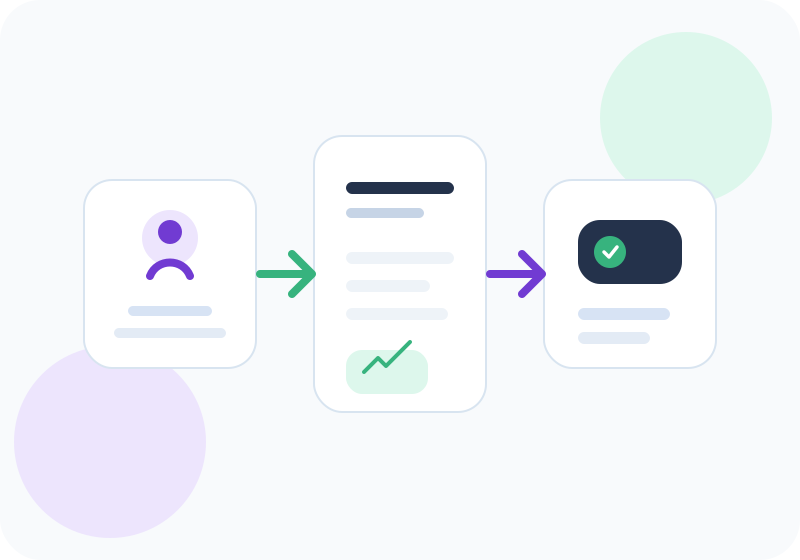
Agency quote approval workflow

A useful client portal software for agencies should help you move from question to usable document quickly. Start with the business context, recipient details where relevant, dates, amounts, taxes, terms, and the next action. For everyday work, this keeps client portal software for agencies clear enough for freelancers, agencies, consultants, and small teams without rebuilding the workflow every time.
| What to check | Why it matters | InvoiceGennie flow |
|---|---|---|
| Document details | Number, date, validity, and due date reduce approval confusion. | Edit the page directly and download the PDF immediately where the editor is available. |
| Review fields | Correct identity, amount, and tax details avoid back-and-forth later. | Use related tools and examples to keep the next step consistent. |
| Workflow next step | One-off documents are useful, but tracking matters once volume grows. | Move to the dashboard when you need saved records and follow-ups. |
In 2026, buyers expect billing workflows to be fast, readable, mobile-friendly, and easy to revise. Agency quote approval workflow If you use this client portal software for agencies once, keep the output simple. If you repeat the same workflow every week, save clients, standardize terms, and track follow-ups in one workspace.
The fastest path is to use the client portal software for agencies above, download the result, and move into InvoiceGennie when you need saved clients, reminders, payment tracking, and cleaner billing records.
Agency scope arguments follow a pattern. Work expands gradually, nobody re-papers it, and three months later there is a disagreement about what the retainer covered. Both sides are usually sincere and both are reconstructing from memory and a scattered email thread.
What ends it quickly is a dated record showing what was approved and by whom. That is the whole case for a portal, and it is why the approval trail matters more than the file sharing, the messaging or the dashboard — features that look better in a demo and get used less.
Every portal works when the client logs in. The differences show up in whether they do. A client juggling six vendors will not maintain a seventh password, and the moment they email you a question instead of opening the portal, your record of the conversation splits in two.
This is why frictionless access beats richer functionality for client-facing tools. The portal that gets opened is worth more than the one with better features, because a record only helps if both sides actually used it.
Only when it requires nothing of them. A link that opens the document, shows the status, and offers one action gets used. Anything with a password to remember loses to email within a month, which is why share-link portals outperform account-based ones for client-facing work.
It is evidence rather than a contract. A timestamped approval against a named recipient is considerably stronger than "they said yes on a call", and for most scope disputes that is what actually matters. For work where enforceability matters, the portal approval supplements a signed agreement, it does not replace one.
Version control and status. Emailed PDFs fork — the client is looking at v2 while you are discussing v4, and neither of you knows. A portal has one current document and a record of who saw what when.
Per-client separation is essential; per-client logins are optional. Scoped share links give you the separation without the adoption cost, provided the links are unguessable and can be revoked.
If you are still comparing tools, create one invoice, quote, receipt, or reminder first. A real document test reveals workflow fit faster than a feature list.
Create free invoiceUse these linked tools to complete your billing and collections workflow.
Tool
Use InvoiceGennie free invoice generator to create invoice PDF online. Add GST, HSN or SAC, UPI QR, logo, client details, and download without signup.
Tool
Create GST invoices online with CGST, SGST, or IGST-ready totals, GSTIN fields, HSN or SAC-friendly lines, and downloadable PDF output for India billing.
Tool
Create professional payment reminder messages with invoice details, due date, and outstanding amount.
Practical guides that help teams execute invoicing and accounting workflows faster.
Guide
Learn how to create a professional invoice with GST, payment terms, and due dates using a simple step-by-step framework.
Guide
Understand invoice vs bill differences, when to use each term, and how payment workflows change in B2B operations.
Guide
See a practical GST invoice example with required fields, tax breakup, and formatting tips for Indian businesses.
Browse professional invoice, receipt and credit note templates.
Client-retainer and milestone invoice examples for agencies.
Structure winning quotes with terms, taxes and validity.
Use proforma formats before goods dispatch or project kick-off.
See how to bill retainers with period coverage, scope summary, and payment terms.
Learn the billing structure Indian service teams use for GST-ready invoices.
Create the document you need now, then use related formats and reminders to complete the billing workflow.